American bison
Killers of the Flower MoonThe American bison was both a source of sustenance and a foundation of Osage communal life. Its disappearance was not simply the loss of a species: it helped sever a people from the practices and independence that had shaped life on the plains.
The Hunt and Its Uses
Twice each year, Osage families packed clothing, bedding, utensils, dried meat, and weapons onto horses and left for a sacred, two-month hunt. When scouts found a herd, hunters raced across the plains on horseback. A French medical student who accompanied an Osage hunt in 1840 described the pursuit as relentless: the bison doubled back, tried to escape, and could turn against its pursuers. The hunters approached with bows and arrows, which the Osage considered more effective than bullets.
The hunt made use of the animal far beyond its meat. After a kill, the tail could be kept as a trophy; meat was dried, the heart smoked, and the intestines made into sausages. Bison-brain oils were rubbed over hides that became leather for robes and lodge coverings, while horns supplied spoons, sinews bowstrings, and tallow fuel for torches. The animal’s place in this life was practical and encompassing: its body supplied materials for daily needs, and the hunt connected those needs to shared movement across the plains.
The Herds’ Disappearance and Its Consequences
As the herds dwindled, the hunt became an encounter with a vanishing past as well as a search for food. Osage people continued to travel after bison, and an accompanying white trader remembered older men gathering around campfires to recount earlier feats in war and in the chase. The journey kept memory alive, but it could not restore the world the stories recalled.
By 1877, there were virtually no American bison left to hunt. Their destruction had been accelerated by authorities who encouraged settlers to kill them, recognizing the purpose of that policy in the phrase, “every buffalo dead is an Indian gone.” The loss struck at more than a food supply: it undercut a way of life already pressured by forced migration and by demands that the Osage abandon their own practices.
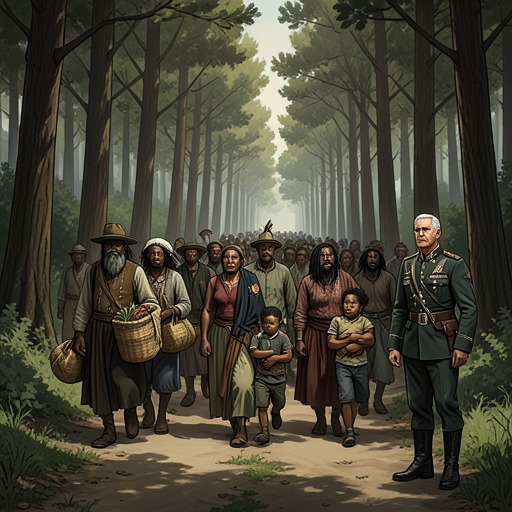
The government withheld annuity payments owed for the sale of Kansas land until able-bodied Osage men, including Ne-kah-e-se-y, took up farming; even then, it insisted on paying in clothing and food rations rather than money. Unaccustomed to white agricultural methods and deprived of the bison, Osage people went hungry, and many died. The disappearance of the herds thus became part of a larger coercion: a people were denied both the animal that had sustained their life on the plains and control over the aid owed to them.
A Self-Sufficient World Under Pressure
The Osage relationship with the bison also stood in contrast to the government’s effort to remake Indigenous life. The hunt drew on detailed knowledge of the animal and used its body with little waste, while the surrounding forests and rivers supplied other necessities. When asked why he did not adopt white ways, an Osage chief answered, “I am perfectly content with my condition. The forests and rivers supply all the calls of nature in plenty.” The bison belonged to a world in which the Osage could describe their own needs and means of meeting them; its near disappearance came as officials pressed them to farm and accept food and clothing rations on government terms.
The Herds and the Loss of Homeland
The bison’s disappearance unfolded alongside the shrinking of the land on which the Osage had hunted. After the United States acquired Louisiana in 1803, the government compelled the Osage within four years to relinquish territory between the Arkansas and Missouri Rivers. Over the following decades, they were forced to cede nearly a hundred million acres and seek refuge in a 50-by-125-mile area in southeastern Kansas. The hunt’s continued place in Osage life therefore carried a territorial dimension: it depended on access to a homeland already being taken away.
That refuge, too, came under pressure from settlers. In 1870, after being driven from their lodges and seeing their graves plundered, the Osage agreed to sell their Kansas lands for $1.25 an acre. Settlers nevertheless massacred several Osage people, mutilating and scalping their bodies. By 1877, with virtually no bison left to hunt, the destruction of the herds and the loss of land had converged as parts of a wider remaking of Indigenous life—not a single rupture, but successive attacks on the means by which a people sustained and governed themselves.
Forced migrations and diseases including smallpox reduced the Osage population, by one estimate, to about three thousand—roughly a third of its size seventy years earlier. The near-disappearance of the bison belongs within that larger history of attrition: the animal had sustained a communal way of life, while its destruction and the seizure of hunting grounds narrowed the possibilities for continuing it.